Updated: December 2025
By: Law Office of Ral Obioha, PLLC – Immigration Attorneys
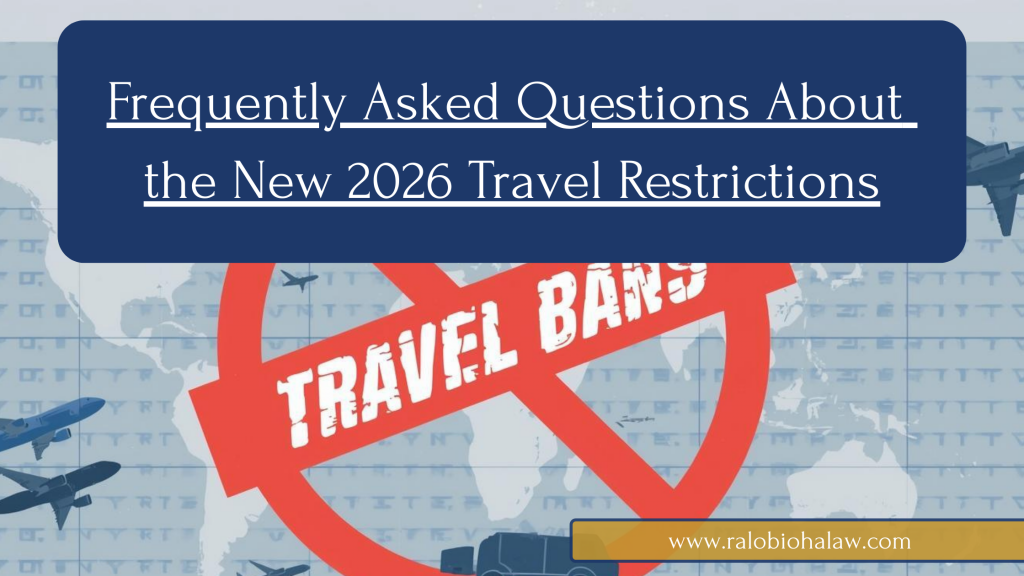
Following the December 16, 2025 Presidential Proclamation expanding travel restrictions to nearly 40 countries, our office has received an overwhelming number of questions from clients, families, employers, and students. This FAQ is designed to help you understand how these new rules may affect you.
For individualized guidance, please schedule a consultation with our office.
1. When does the new Proclamation go into effect?
The expanded travel restrictions take effect January 1, 2026.
This means any visa interviews, entries, or filings occurring on or after this date may be impacted by the new rules.
2. What exactly did the President announce?
The President issued a new Proclamation under INA §212(f) that:
- Expands the list of countries with full entry bans
- Adds new countries to partial suspension lists
- Converts some countries from partial to full suspension
- Narrows certain immigration exceptions
- Imposes stricter security vetting
This Proclamation builds on earlier travel restrictions issued in 2025.
3. What is a “Full Suspension”?
A full suspension is a comprehensive travel ban.
It means:
- ❌ No immigrant visas
- ❌ No non-immigrant visas
- ❌ No entry into the U.S. at all
- ❌ CBP may deny entry even at the border
Only narrow waivers exist, and they are rarely granted.
4. What is a “Partial Suspension”?
A partial suspension blocks specific visa types, such as:
- B-1/B-2 visitor visas
- F/M student visas
- J exchange visas
- Most immigrant visas
Other visa categories may still be possible.
5. Which countries are under Full Suspension?
19 countries, plus individuals using Palestinian Authority travel documents, are now fully suspended.
Previously fully suspended:
Afghanistan, Burma, Chad, Congo, Equatorial Guinea, Eritrea, Haiti, Iran, Libya, Somalia, Sudan, Yemen.
New additions:
Burkina Faso, Mali, Niger, South Sudan, Syria, and PA travel document holders.
Upgraded to full suspension:
Laos, Sierra Leone.
6. Which countries are under Partial Suspension?
Existing partial restrictions:
Burundi, Cuba, Togo, Venezuela.
New partial restrictions:
Angola, Antigua & Barbuda, Benin, Côte d’Ivoire, Dominica, Gabon, The Gambia, Malawi, Mauritania, Nigeria, Senegal, Tanzania, Tonga, Zambia, Zimbabwe.
Note:
Turkmenistan’s non-immigrant ban was lifted, but immigrant visa restrictions remain.
7. I have a visa appointment coming up. How will this affect me?
It depends on:
- Your nationality
- Your visa category
- Whether your country is fully or partially suspended
Possible outcomes include:
- Your interview may be canceled
- Your case may be placed in administrative hold
- You may be denied due to the Proclamation
- You may require a waiver
We strongly advise speaking with an immigration attorney before attending your appointment.
8. I already have an issued visa. Can I still enter the U.S.?
In general:
- If your visa was issued before January 1, 2026, you are not affected by the Proclamation.
- However, CBP still has discretion to question or deny entry under security vetting authority.
Travel with caution and carry strong documentation.
9. I am a green card holder. Will this affect me? Can I still travel freely?
Green card holders (LPRs) are exempt from the travel suspension.
However:
- CBP may conduct enhanced vetting
- Extended trips abroad may raise abandonment issues
- LPRs from banned countries should still consult counsel before travel
You can travel, but always consider the risks.
10. Who is NOT affected by the ban?
The Proclamation does not apply to:
- U.S. citizens
- Lawful Permanent Residents
- Individuals with valid visas issued before Jan 1, 2026
- Diplomatic/official visa holders
- Some dual nationals traveling on an unaffected passport (seek legal advice)
11. What happens if I am inside the U.S. right now?
You may still apply for:
- Asylum
- Withholding of removal
- CAT protection
- Adjustment of Status (case-specific)
But expect:
- Longer processing times
- Additional security vetting
- Possible delays in background checks
Do not travel internationally unless advised by counsel.
12. What happens if I am outside the U.S.?
If you are abroad:
- Visa issuance may be blocked
- Interview dates may be canceled
- You may be required to seek a waiver
- Your case may remain pending indefinitely
Each consulate may implement the Proclamation differently.
13. Are waivers available?
Yes, but they are extremely limited.
Applicants must prove:
- Undue hardship
- Entry is in the national interest
- No security threat
Historically, waiver approvals under similar bans have been very low.
14. I am a U.S. citizen. Can I still petition for my spouse or parents?
Yes, you can file the petition.
However:
- The case may be delayed
- Visa issuance may be blocked
- A waiver may be needed for consular processing
Still file. Establishing priority dates is crucial.
15. What should I do ASAP if I’m from an affected country?
We recommend:
✔ Consult an immigration attorney
✔ Do not travel without legal guidance
✔ Prepare for delays
✔ Explore alternative visa options
✔ Gather documentation of hardship (for waiver possibilities)
✔ Stay informed, policies may shift
We Can Help You Navigate This
These new restrictions affect families, students, businesses, and individuals around the world. Every situation is different. Don’t guess, get advice tailored to your case.
You don’t have to navigate this alone. We are here to guide you every step of the way.
Warmly,
📧 Email Us: hello@ralobiohalaw.com
📞 Call: (713) 234-1100
Stay Connected:
Disclaimer: The information in this post is for educational purposes only and does not constitute legal advice. Consultation with qualified counsel is recommended for individual cases.