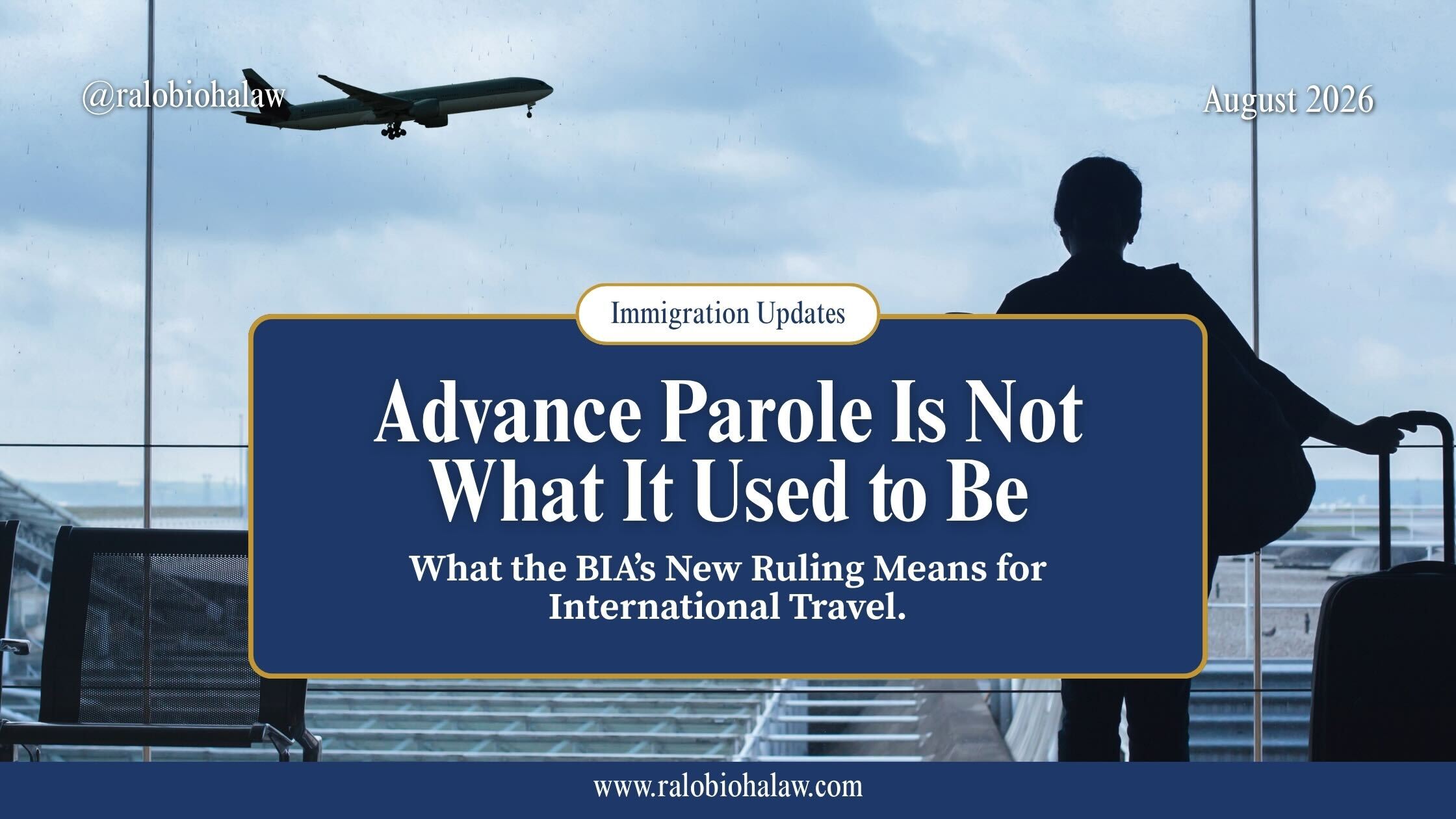
Advance Parole is Not What It Used to Be:
What the BIA’s New Ruling Means for International Travel
By Ral Obioha, Esq. LLM
Board Certified Specialist – Immigration & Nationality Law
For years, many immigrants with pending adjustment of status applications have relied on Advance Parole to travel internationally while their green card cases remained pending.
A major new decision from the Board of Immigration Appeals (BIA), however, has changed an important part of the legal landscape.
On August 13, 2026, the BIA issued Matter of Delcarmen-Lara, 29 I&N Dec. 830 (BIA 2026), holding that travel outside the United States pursuant to Advance Parole constitutes a “departure” for purposes of the unlawful presence provisions of INA § 212(a)(9)(B). In doing so, the BIA expressly overruled its longstanding 2012 decision in Matter of Arrabally and Yerrabelly.
For immigrants considering international travel, particularly those who accumulated unlawful presence before filing for adjustment of status, this is a significant development.
What Is Advance Parole?
Advance Parole is a travel document that may allow certain noncitizens who are physically present in the United States to travel internationally and seek parole back into the United States without necessarily abandoning a pending immigration application.
For example, an individual with a pending Form I-485, Application to Register Permanent Residence or Adjust Status, may obtain Advance Parole and use it to travel abroad while the adjustment application remains pending.
But there is an important distinction that every traveler should understand:
Advance Parole is permission to seek parole back into the United States. It is not a guarantee of admission, and it does not erase other grounds of inadmissibility.
The new BIA decision makes that distinction particularly important for individuals who have previously accrued unlawful presence.
What Changed?
For approximately 14 years, immigration attorneys and applicants relied on the BIA’s decision in Matter of Arrabally and Yerrabelly.
In that case, the BIA held that when someone temporarily traveled outside the United States pursuant to Advance Parole, that travel was not considered a “departure” for purposes of triggering the unlawful presence bars under INA § 212(a)(9)(B). The BIA reasoned, in part, that Advance Parole travel was different because the traveler was authorized to leave with the expectation of returning to continue pursuing a pending adjustment application.
That rule has now been overruled.
In Matter of Delcarmen-Lara, the BIA concluded that the statutory language does not create an exception for Advance Parole. According to the Board, leaving the United States pursuant to Advance Parole is still a departure for purposes of INA § 212(a)(9)(B)(i)(II).
That change can have serious consequences.
Why Does This Matter for International Travel?
The unlawful presence bars are generally triggered when a person accumulates a specified amount of unlawful presence and then departs the United States.
Generally, more than 180 days but less than one year of unlawful presence can result in a 3-year bar after departure, while one year or more of unlawful presence can result in a 10-year bar after departure.
The BIA decision specifically addressed the 10-year unlawful presence bar under INA § 212(a)(9)(B)(i)(II), which applies to certain individuals who accumulated at least one year of unlawful presence and then seek admission within 10 years of their departure or removal.
Previously, an adjustment applicant who qualified under Matter of Arrabally and Yerrabelly could potentially travel with Advance Parole without that trip itself constituting the departure that triggered the unlawful presence bar.
Under the BIA’s new interpretation, Advance Parole no longer provides that protection.
The Board expressly stated that a person may become inadmissible under INA § 212(a)(9)(B) because of an international trip taken pursuant to Advance Parole.
Having an Approved Advance Parole Document Does Not Mean International Travel Is Risk-Free
This is one of the most important takeaways from the decision.
Someone may have a pending I-485, a valid Employment Authorization Document, an approved Advance Parole document, and a legitimate reason to travel internationally. None of those facts, standing alone, answers the question of whether that person should actually leave the United States.
The person’s entire immigration history matters.
Before international travel, it may be necessary to determine whether the person previously accumulated unlawful presence, how much unlawful presence was accumulated, whether any statutory exceptions apply, whether another ground of inadmissibility exists, and what consequences could follow from the departure.
In fact, the BIA noted that Advance Parole documents historically warned travelers that they could nevertheless be found inadmissible and potentially become ineligible for adjustment of status without an applicable waiver.
Having Advance Parole and being legally safe to use Advance Parole are not necessarily the same thing.
What About Someone Who Overstayed a Visa?
This is where careful legal analysis becomes especially important.
Imagine someone entered the United States lawfully but later overstayed their authorized period of stay. The person subsequently became eligible to file for adjustment of status, filed an I-485, and received Advance Parole.
The existence of the pending I-485 and Advance Parole document should not automatically be interpreted as a green light for international travel.
If the individual accumulated sufficient unlawful presence before filing the adjustment application, leaving the United States after the new BIA decision could potentially trigger an unlawful presence bar.
That could fundamentally change the person’s immigration strategy and potentially create a need to address inadmissibility before permanent residence can be granted.
Anyone with a history of overstay or unlawful presence should therefore have their immigration history reviewed before using Advance Parole for international travel.
Does This Mean Nobody With Advance Parole Should Travel?
No.
The decision does not say that Advance Parole has been eliminated, nor does it hold that every person who travels with Advance Parole becomes inadmissible.
The critical issue addressed by Delcarmen-Lara is whether an Advance Parole trip counts as a departure for purposes of the unlawful presence ground of inadmissibility.
For many adjustment applicants who have not accumulated unlawful presence that would trigger INA § 212(a)(9)(B), this particular ruling may not create the same problem.
That is why broad statements such as “Advance Parole is no longer safe” or “nobody should travel” oversimplify the decision.
The better question is: What happens under my particular immigration history if I leave the United States?
What If You Already Traveled on Advance Parole?
There is an important limitation in the BIA’s ruling.
The Board recognized that Matter of Arrabally and Yerrabelly had been longstanding precedent and that people had relied upon that rule. It therefore determined that its new interpretation would apply prospectively, rather than retroactively.
This distinction matters tremendously.
Someone who previously traveled pursuant to Advance Parole while Arrabally and Yerrabelly controlled should not automatically assume that the new decision retroactively makes that prior trip a triggering departure.
At the same time, anyone contemplating new international travel after this decision should have their circumstances evaluated under the new rule.
International Travel Now Requires More Careful Planning
The biggest practical lesson from Matter of Delcarmen-Lara is that Advance Parole should not be viewed simply as a travel permit.
Before booking an international trip, an Advance Parole holder, particularly someone with an overstay or other complicated immigration history, should understand how they originally entered the United States; whether and when they fell out of lawful status; whether they accumulated unlawful presence; how much unlawful presence they accumulated before filing their current application; whether an exception applies; whether departure could trigger a 3-year or 10-year bar; whether other inadmissibility or removal issues exist; and what their immigration options would be if a problem arises after departure.
A vacation, family visit, wedding, funeral, business trip, or other temporary international trip can have consequences far beyond the length of the trip itself.
The Bottom Line:
Advance Parole remains available, but the legal consequences of using it have changed for certain travelers.
On August 13, 2026, the BIA expressly overruled Matter of Arrabally and Yerrabelly and held that leaving the United States pursuant to Advance Parole is a “departure” for purposes of the unlawful presence provisions addressed in Matter of Delcarmen-Lara.
For individuals who have accumulated significant unlawful presence, that means international travel with Advance Parole may now trigger serious immigration consequences that previously could have been avoided under Arrabally.
If you have Advance Parole and are considering traveling internationally, particularly if you have ever overstayed a visa, entered without inspection, had a prior removal order, or have another complicated immigration history, do not assume that an approved travel document means it is safe for you to leave the United States.
Have your immigration history reviewed before you travel, not after you have already boarded the flight.
At Ral Obioha Law, we help individuals and families understand how changes in immigration law affect their pending cases and international travel plans. If you have Advance Parole and are considering traveling outside the United States, schedule a consultation so that your individual immigration history and potential risks can be evaluated before departure.
Disclaimer: This article is provided for general informational purposes only and does not constitute legal advice. Immigration consequences depend on the specific facts and history of each case.
Warmly,
Ral Obioha, Esq. LLM
Board Certified Attorney in Immigration and Nationality Law
Ral Obioha Law, PLLC
Let’s talk. We offer consultations to help you understand your options and take the next steps.
📧 Email Us: hello@ralobiohalaw.com
📞 Call: (713) 234-1100
Stay Connected:
This blog post is for informational purposes only and does not constitute legal advice. Please consult with a qualified immigration attorney regarding your individual circumstances.